Why ADU Builder Websites Don’t Convert

How most ADU websites unintentionally repel serious homeowners and what actually turns website visitors into booked consultations.
Table of Contents
Most ADU and tiny home builder websites look professional. They showcase beautiful projects, list services, and include testimonials. From a branding standpoint, they do their job. From a lead generation standpoint, they quietly fail.
The problem is not aesthetics. The problem is intent.
Traditional builder websites are designed to inform, not convert. They assume that interested homeowners will figure out the next step on their own. In reality, most visitors skim a few pages, feel overwhelmed or uncertain, and leave without ever reaching out.
This creates a frustrating disconnect. Builders invest in SEO, ads, or social media, traffic increases, but leads do not.
Homeowners researching ADUs arrive with uncertainty. They are asking themselves questions like:
When a website does not clearly answer these questions or provide a guided next step, visitors hesitate. A generic “Contact Us” button is not enough to overcome uncertainty. Asking homeowners to initiate contact without context feels risky to them.
As a result, they leave to continue researching or compare other builders. The opportunity disappears without any indication that it was ever there.
Websites that convert are built around behavior, not just branding. They acknowledge that homeowners need guidance and reassurance before taking action.
High-converting ADU websites typically:
Instead of forcing visitors to explore, they guide them. Instead of overwhelming them with options, they simplify decision-making.
This is not about aggressive sales language. It is about clarity.
The key difference between a traditional website and a funnel is intent alignment.
A funnel-based site assumes that visitors are at different stages of readiness. Some are just learning. Others are nearly ready to build. Funnels meet homeowners where they are and move them forward step by step.
Funnels combine:
Traditional websites hope visitors will take action. Funnels are designed to make action feel natural and safe.
ADU Funnels was built specifically to address this gap. Instead of replacing a builder’s brand, it enhances it with structure.
Traffic from Google, ads, or referrals is sent to purpose-built landing pages that:
From there, ADU Funnels handles automated responses, scheduling, and follow-up. No lead is left waiting. No opportunity is lost due to slow response times.
The result is a website ecosystem that works like a digital salesperson, guiding homeowners toward consultations even outside business hours.
Not necessarily. Many builders use funnels alongside their main site to capture and convert traffic.
Yes. Funnels often unlock value from traffic you already have but are not converting.
No. When done correctly, it feels helpful and professional, not sales-driven.

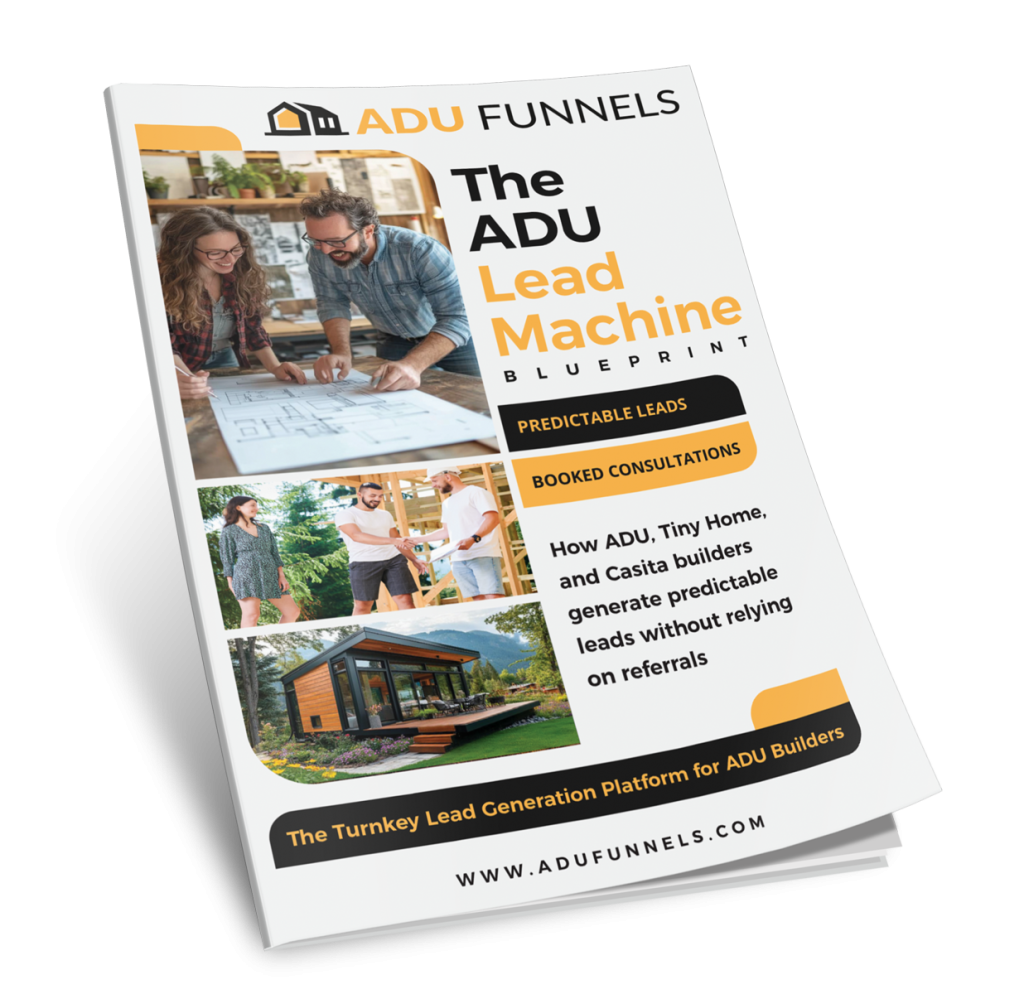
The turnkey lead generation and marketing platform built exclusively for ADU, tiny home and casita contractors ready to increase visibility, capture more leads and close more projects with a fully managed system that handles ads, funnels, follow up and lead nurturing for you.